
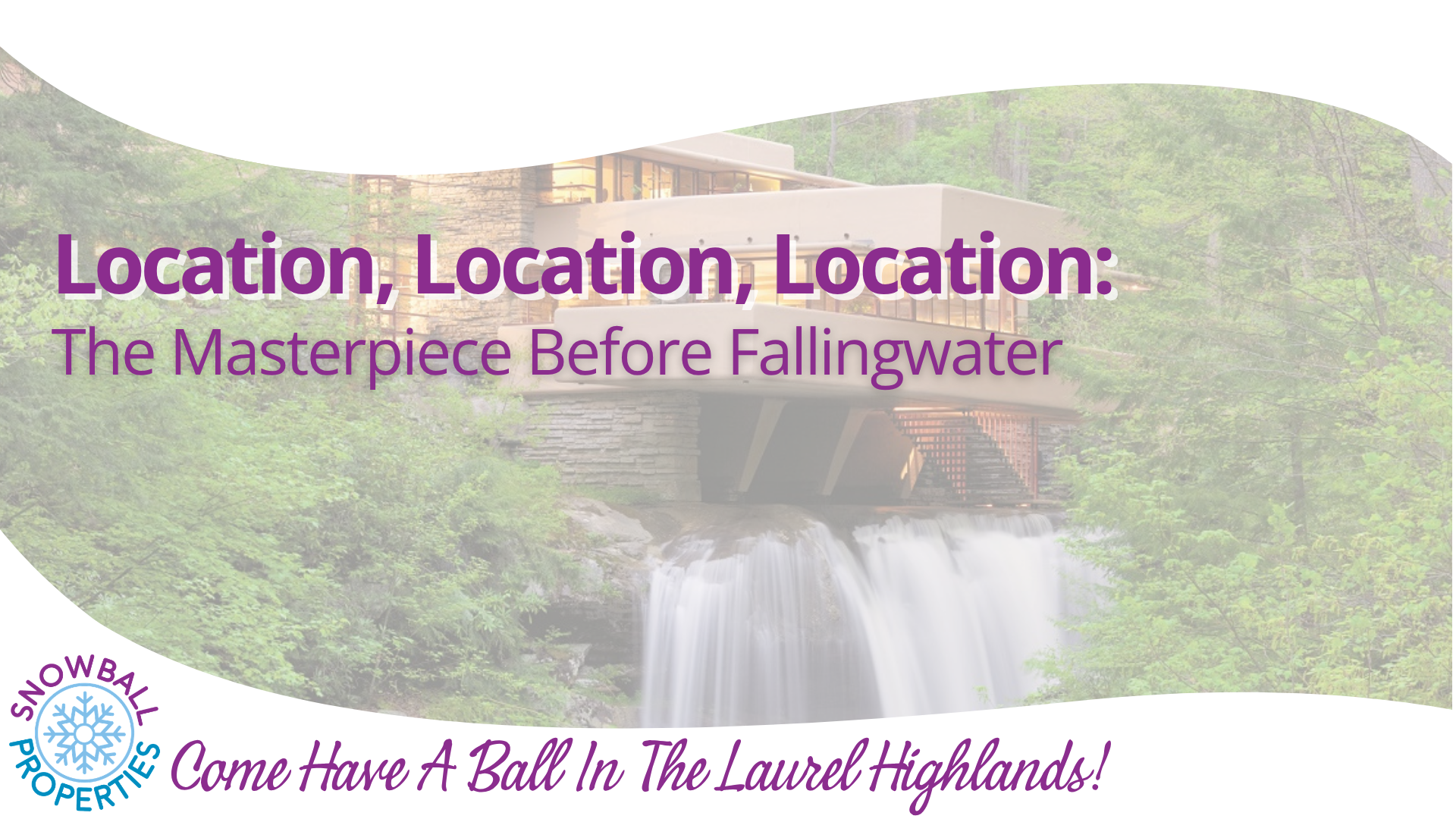
Location, Location, Location: The Masterpiece Before Fallingwater
You’ve probably seen the pictures. A famous Frank Lloyd Wright house hovering over a waterfall, surrounded by thick Pennsylvania forest.
But here’s the part of the Fallingwater story we find even more interesting: Why would someone decide to build a house here?
Not near the waterfall. Not overlooking the waterfall. Right on top of it.
Turns out, Fallingwater’s location wasn’t simply a dramatic backdrop for a famous house. The waterfall, Bear Run, rocky terrain, and surrounding Laurel Highlands landscape were the whole reason the house came to exist in the first place.
So, SNOWBALLERS, we’re heading into the woods for this one. Because to understand Fallingwater, you must start with what was there long before Frank Lloyd Wright ever showed up.
Before Fallingwater, There Was Bear Run
Long before Fallingwater became one of Pennsylvania’s most recognizable landmarks, Bear Run was already a getaway.
Edgar and Liliane Kaufmann were part of the prominent Pittsburgh family behind Kaufmann’s Department Store. They regularly escaped the city for the mountains of southwestern Pennsylvania, where they could trade Pittsburgh’s industrial air for forests, streams, fishing, swimming, and time outdoors. The Kaufmann connection to Bear Run stretched back years before Fallingwater was conceived, including a summer camp established there for department-store employees in 1916.
By the time they decided to build a new weekend home in 1934, the Kaufmanns owned the wooded property surrounding the waterfall. They weren’t shopping around for a pretty piece of land. They already loved this one. And honestly, we get it.
Bear Run tumbles through a landscape shaped by layers of sandstone, shale, and limestone. Over millions of years, moving water carved through the softer rock while cascading over harder sandstone ledges, creating the waterfalls that caught the Kaufmann family’s attention in the first place.
Before there was an architectural masterpiece, there was already a natural one.
Plot Twist: You’re Living Above the Waterfall
When the Kaufmanns asked Frank Lloyd Wright to design their mountain retreat, they expected something fairly straightforward: a house positioned where they could look at their beloved waterfall.
But if you’ve seen much of Wright’s work, you probably already know “fairly straightforward” wasn’t exactly his thing. Wright had another idea.
After visiting Bear Run in December 1934, he envisioned a home extending directly over the falls instead. Rather than making the waterfall something the family admired through a window, Wright made it part of everyday life.
Bold move, Frank.
That decision is exactly why Fallingwater could never simply be picked up and placed somewhere else. The house would become one of the defining examples of Wright’s philosophy of “organic architecture,” the idea that a building and its natural surroundings should belong together.
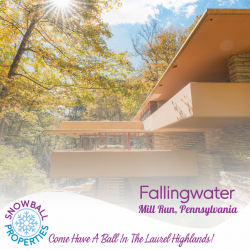
The terraces echo the rock ledges below. Native sandstone quarried from the property was incorporated into the house. Bear Run passes beneath it, and the surrounding forest practically wraps around it. The house wasn’t designed first and assigned a scenic location later. It was designed in response to this exact patch of the Laurel Highlands.
And that’s something photographs can’t quite capture. You can see the famous terraces in a picture, but you can’t hear Bear Run rushing beneath the house, take in the scale of the surrounding forest, or experience the way Fallingwater seems to emerge from the landscape instead of simply sitting on it.
Maybe that’s why this house in the Pennsylvania mountains became so much bigger than a family retreat. Fallingwater opened to the public in 1964, and in 2019, it joined seven other Frank Lloyd Wright sites on the UNESCO World Heritage List.
Turns out, building a house on top of a waterfall worked out pretty well.
Pressed for Time? Here’s the Breakdown:
- Fallingwater is here because Bear Run was here first. The Kaufmann family loved this particular mountain retreat long before the house was built.
- Wright surprised the Kaufmanns by building over the waterfall instead of facing it, making the landscape part of the home itself.
- Visiting Fallingwater is as much about experiencing the Laurel Highlands landscape as seeing the architecture.
Fallingwater is a pretty good reminder that sometimes the location really does make the getaway. And if seeing it has you ready to spend a few days exploring waterfalls, trails, mountain towns, and everything else around Seven Springs and the Laurel Highlands, SNOWBALL PROPERTIES would love to be your home base.
Our sister company, BEACHBALL PROPERTIES, has years of hospitality experience and has earned Airbnb Superhost and Vrbo Premier Partner recognition along the way. Different landscape, same goal: giving our guests a stay worth remembering.
Come Have A Ball In The Laurel Highlands!
– Ginger & Hunter Harrelson